
Ceramics for Energy Applications
Advanced ceramic materials enabling energy conversion, storage, and transport
Ceramics are a broad class of inorganic, non‑metallic materials that play a central role in modern energy technologies due to their unique combination of thermal stability, chemical robustness, and tunable transport properties. These characteristics make ceramics indispensable in environments where conventional materials fail, particularly under high temperatures, reactive atmospheres, and long-term operation.
Within this family, oxide ceramics play a central role in many energy technologies because they can conduct ions and electrons. Perovskites are an important type of oxide ceramic.
From ABO₃ to A₂B₂O₆: Designable Perovskites for Energy Technologies
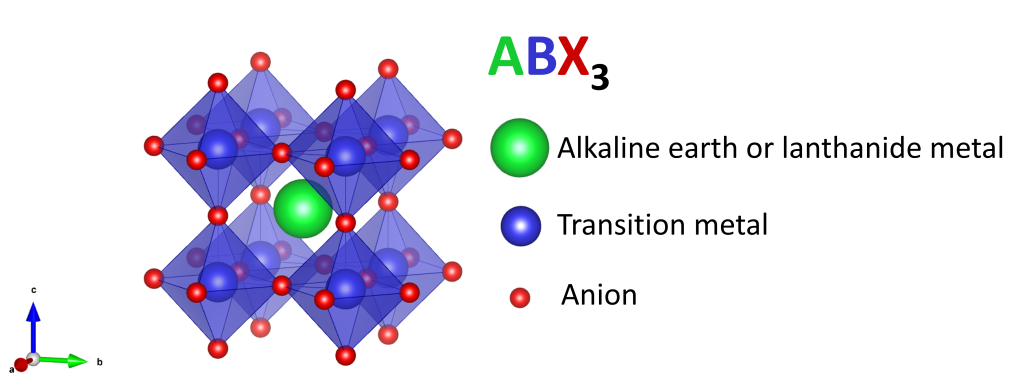
“Their high chemical and structural tunability allows perovskites to be used in a broad spectrum of energy and catalysis technologies.”
What are Perovskites?
Perovskite and double perovskite oxides, with archetypal formulas ABO₃ and A₂B₂O₆, are crystalline frameworks that can host a wide variety of elements on their A and B sites. By tailoring this cation chemistry and the degree of cation ordering, one can systematically adjust lattice distortions, defect concentrations, and electronic structure. Thereby, perovskites can exhibit a wide range of physical properties such as ionic conductivity or ferromagnetism, which are influenced by their structure and composition. Their high chemical and structural tunability allows perovskites to be used in a broad spectrum of energy and catalysis technologies.
Where Do We Meet Perovskites in Everyday Life?
Perovskite materials have emerged as a game-changer in solar technology, offering higher efficiency and lower costs than traditional silicon-based panels.
Perovskites enable high-efficiency, lightweight electronics like displays, sensors, photodetectors, and memory devices with better performance.
Perovskites are enhancing LED technology by enabling brighter, more energy-efficient lights with vivid colors and lower production costs.
Perovskites enhance X-ray and CT scan imaging by improving signal detection for clearer, more accurate images with lower radiation doses.
Perovskites are transforming energy storage, battery efficiency, and power conversion, providing lower costs and enhanced performance for renewable energy systems.
Perovskites can improve battery efficiency, charging speed, and range, enabling longer-lasting and more affordable EVs with faster charging times and greater overall performance.
Why Perovskites for Energy Technologies?
Tunability and Versatility
Perovskites are highly tunable materials, enabling precise control of their optical, electrical, and structural properties. This versatility makes them ideal for a wide range of applications, from solar cells to energy storage systems and electrochemical devices.
Affordability
Perovskites can be produced through low-cost manufacturing processes, such as solution processing and printing techniques. These methods enable scalable production at significantly lower costs than traditional materials, making them accessible for large-scale energy technologies such as solar panels and batteries.
High Efficiency
The high power conversion efficiency of perovskites, particularly in solar cells, rivals that of traditional silicon-based technologies. This efficiency is a key driver in the development of next-generation renewable energy sources, enabling more effective harnessing of solar energy.
Scalability
Perovskites are scalable materials that can be produced in large quantities for commercial applications. Their ability to be manufactured on a variety of substrates, including flexible materials, opens the door to novel, lightweight and integrated technologies such as wearable electronics and smart windows.
Sustainability
Their low-cost and high-efficiency nature aligns well with sustainable development goals. Perovskites are being explored for carbon-neutral technologies, such as green hydrogen production and environmentally friendly batteries, contributing to global efforts in mitigating climate change and advancing clean energy.
High Efficiency
The high power conversion efficiency of perovskites, particularly in solar cells, rivals that of traditional silicon-based technologies. This efficiency is a key driver in the development of next-generation renewable energy sources, enabling more effective harnessing of solar energy.
Application Areas in Energy Technologies – Going beyond Academia
Research on advanced ceramic materials extends beyond fundamental science, contributing directly to industrial innovation, technology scale-up, and sustainable energy system development. By bridging materials design, electrochemical characterization, and application-driven performance, ceramic research supports the translation of laboratory discoveries into real-world energy solutions. These advancements underpin emerging energy infrastructures and help accelerate the transition toward climate-neutral energy systems.
Perovskite Materials in High-Temperature Electrolyzers
Advanced oxygen-conducting perovskites used as electrocatalytic electrode material in high-temperature electrolysis can be broadly categorized based on their dominant transport properties and functional roles within electrochemical devices. Two core material platforms are particularly relevant:
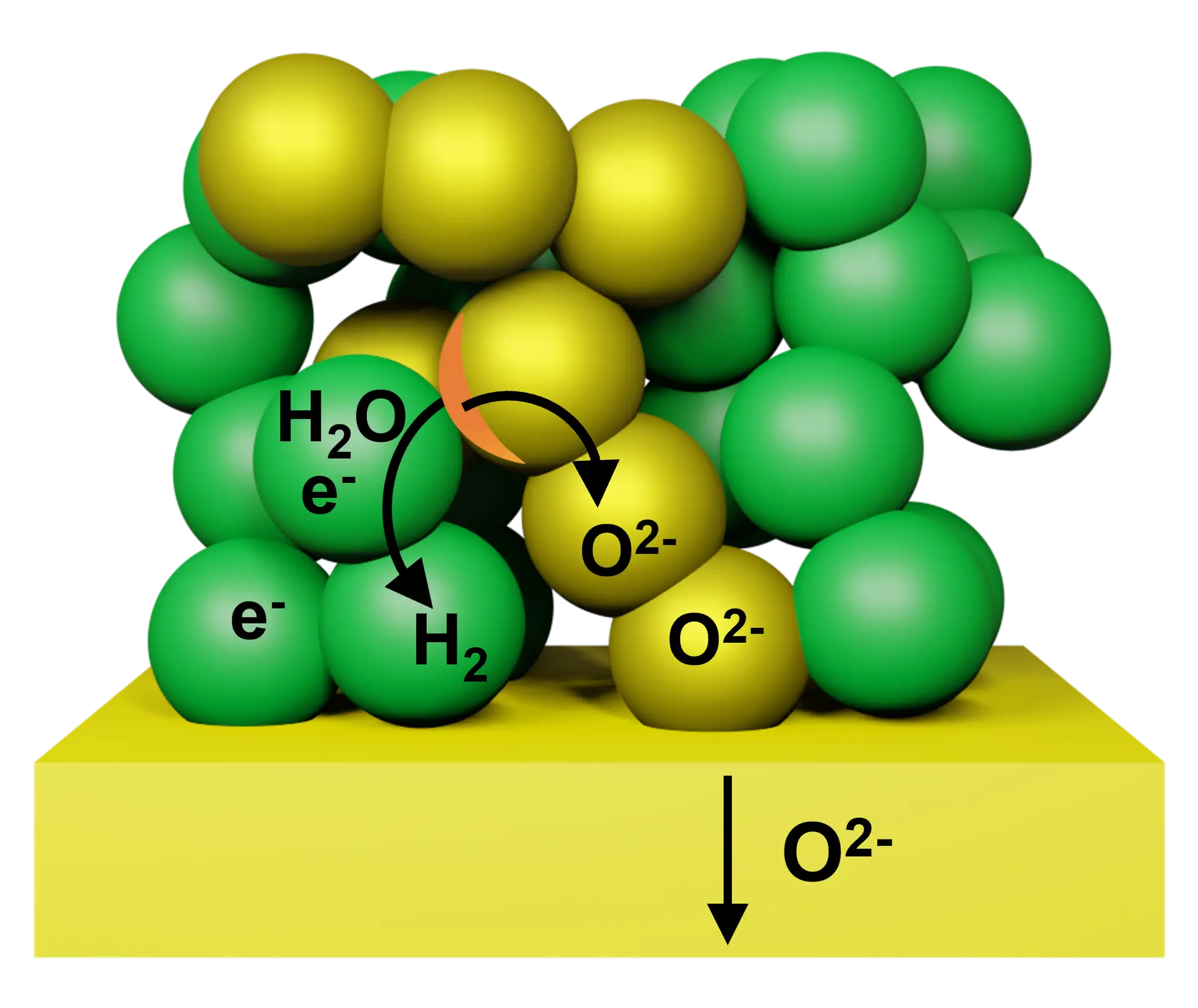
Ion-conducting Ceramic-Metal materials (Cermets, e.g., Ni-Yttria stabilized Zirconia) and functional ceramics with Mixed Ionic–Electronic conductive Properties (MIECs, e.g., SrFeMoO3).
Ceramic–Metal Composites
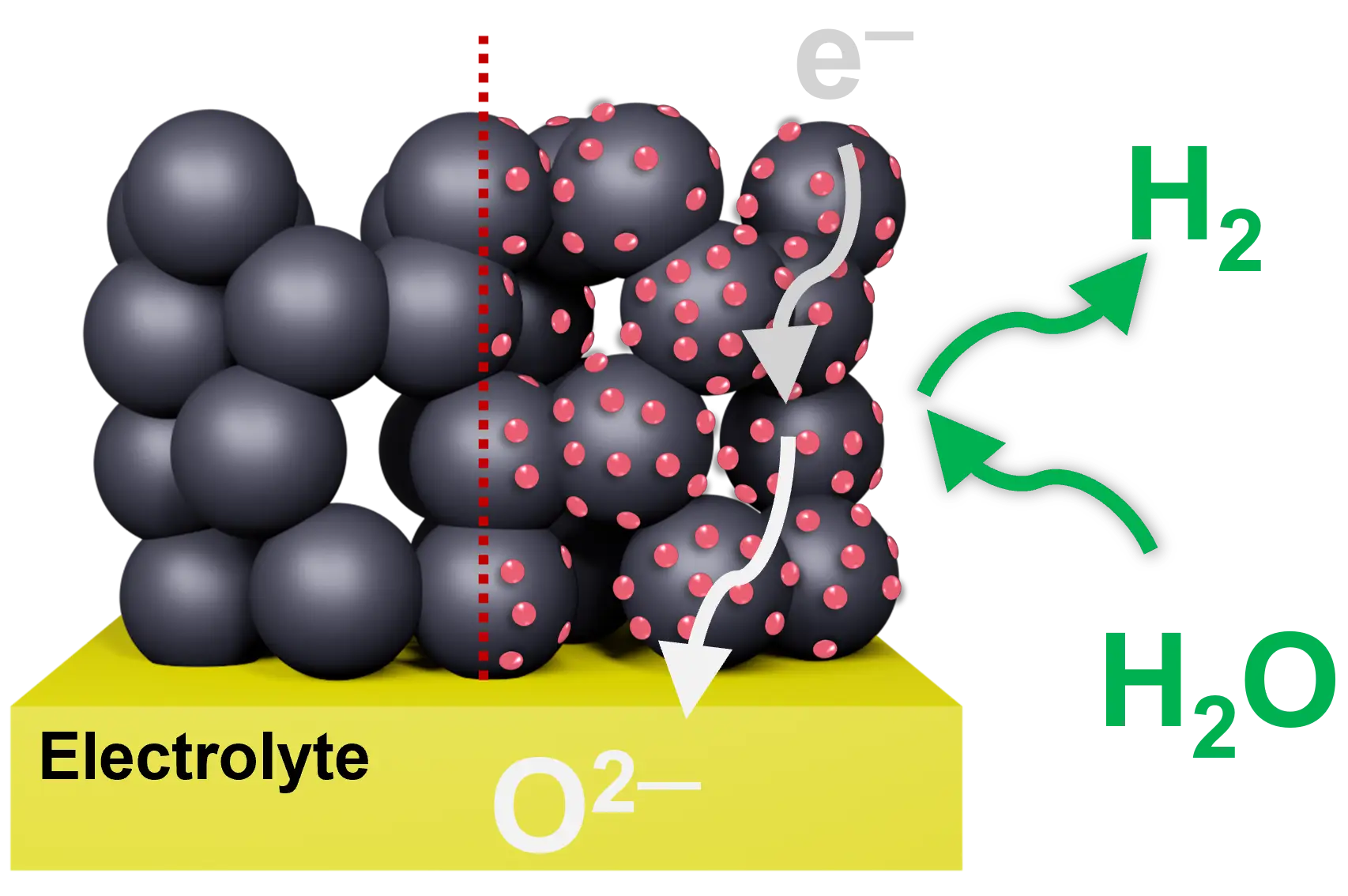
Ceramic–metal composites combine the functional advantages of ceramic phases with the electronic conductivity and mechanical resilience of metallic components. By integrating ionic transport, electronic conduction, and catalytic activity within a single microstructure, cermets enable efficient electrochemical reactions while maintaining structural integrity under demanding operating conditions.
Ceramic–Metal Composites
Ceramic–metal composites combine the functional advantages of ceramic phases with the electronic conductivity and mechanical resilience of metallic components. By integrating ionic transport, electronic conduction, and catalytic activity within a single microstructure, cermets enable efficient electrochemical reactions while maintaining structural integrity under demanding operating conditions.
References & Further Reading
Perovskites in Energy Technologies
- Jena, A.K., Kulkarni, A., and Miyasaka, T. Halide Perovskite Photovoltaics: Background, Status, and Future Prospects, Chem. Rev., 2019.
- Kojima, A. et al. Organometal Halide Perovskites as Visible‑Light Sensitizers for Photovoltaic Cells, J. Am. Chem. Soc., 2009.
- Green, M.A. et al. Solar Cell Efficiency Tables, Prog. Photovolt., 2022.
Solid Oxide Electrolysis Cell Materials
- Wolf, S.E., Winterhalder, F.E., Vibhu, V., de Haart, L.G.J., Guillon, O., Eichel, R.-A., & Menzler, N.H. Solid oxide electrolysis cells – Current material development and industrial application, J. Mater. Chem. A, 2023, 11, 17977–18028. DOI: 10.1039/D3TA02161K. :contentReference[oaicite:0]{index=0}
Energy Storage Materials
- Goodenough, J.B., and Kim, Y. Challenges for Rechargeable Li Batteries, Chem. Mater., 2010.
- Manthiram, A. Materials Challenges and Opportunities for Lithium Batteries, Nat. Commun., 2020.
- Tarascon, J.M., and Armand, M. Issues and Challenges Facing Rechargeable Lithium Batteries, Nature, 2001.
Energy Conversion Applications
- Kim, H.-S., et al. High‑Efficiency Perovskite Solar Cells, Nat. Energy, 2016.
- Stranks, S.D., and Snaith, H.J. Metal‑Halide Perovskites for Photovoltaic and Light‑Emitting Devices, Nat. Nanotechnol., 2015.
Energy Management & Device Applications
- Li, X., et al. Perovskite‑Based Sensors and Switches for Energy Systems, Adv. Mater., 2021.
- Chen, Q., et al. Perovskite Materials in Integrated Energy Devices, J. Mater. Chem. A, 2020.
General References
- Roose, B., et al. Ceramic Materials in Energy Applications, Wiley, 2018.
- OECD/IEA Materials for Energy Technologies: Challenges and Opportunities, 2020.
- National Renewable Energy Laboratory (NREL) Reports on Advanced Ceramics and Energy Materials.