
Electrolysis Technologies
Advanced electrochemical technologies for hydrogen and sustainable fuel production
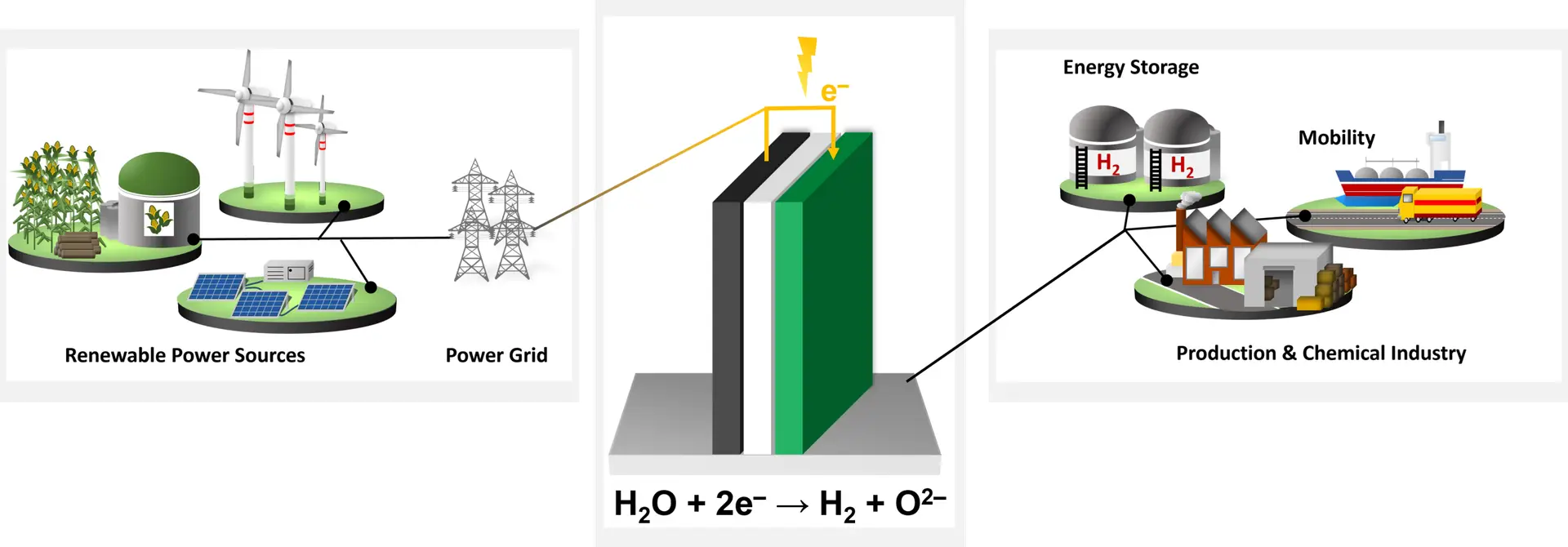
Electrolyzers, which use electricity to split water into hydrogen and oxygen, are critical to building a low‑carbon hydrogen economy as nations seek to decarbonize hard-to-abate sectors.
What Is Electrolysis?
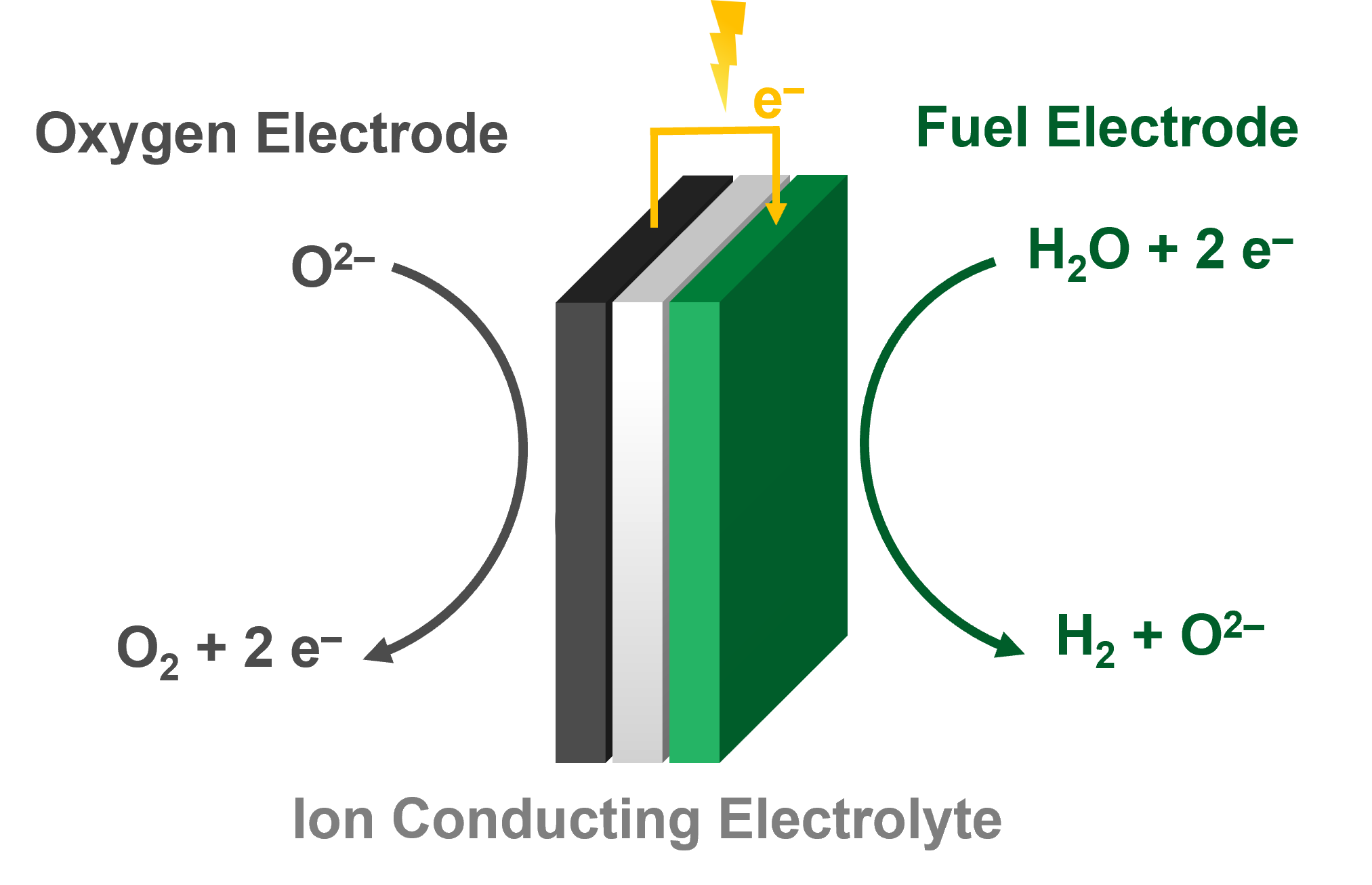
Electrolysis is the electrochemical process that converts electrical energy into chemical energy by splitting water into hydrogen and oxygen. When an external voltage is applied, water molecules at the cathode are reduced to form hydrogen gas, while water oxidation at the anode releases oxygen. The efficiency of this process depends on the ionic conductivity of the electrolyte, the catalytic activity of the electrodes, and the ability of the system to manage heat and mass transport.
In the context of a transition to sustainable energy systems, electrolysis enables the direct storage of renewable electricity in the form of hydrogen — a versatile energy carrier that can be stored, transported, and later reconverted into electricity or used as a feedstock for chemical synthesis. Hydrogen produced through electrolysis can decarbonize sectors such as steel manufacturing, refining, and chemical synthesis, and can serve as a building block for power-to-X pathways (e.g., synthetic fuels, ammonia).
Electrochemical impedance spectroscopy (EIS) plays a critical role in understanding electrolysis performance and degradation mechanisms. By probing the frequency-dependent response of an electrochemical cell, EIS separates resistive and capacitive contributions arising from bulk ionic transport, interfacial charge transfer, and electrode processes — making it indispensable for optimizing materials and cell designs.
Electrolysis Technology Platforms
Electrolyzers vary in component materials and operating conditions, each optimized for specific conditions of temperature, reactants, and targeted application options.
| Advantages | Disadvantages |
|---|---|
|
|
| Advantages | Disadvantages |
|---|---|
|
|
| Advantages | Disadvantages |
|---|---|
|
|
| Advantages | Disadvantages |
|---|---|
|
|
| Advantages | Disadvantages |
|---|---|
|
|
Materials & Components — Cell Level
The performance and durability of electrolysis technologies are governed not only by operating conditions but fundamentally by the materials and components used within the cell and stack. Transport properties, interfacial stability, and mechanical compatibility between components strongly influence efficiency and degradation behavior. While these fundamental components are common to all electrolysis technologies, their material requirements and operating challenges vary significantly with temperature. In high-temperature electrolysis systems, component design must additionally account for enhanced transport rates, thermochemical effects, and long-term stability under extreme operating conditions.
-
Solid Oxide Electrolyzer
-
Alkaline Electrolyzer
-
PEM Electrolyzer
-
AEM Electrolyzer
-
Protonic Ceramic Electrolyzer
Electrolytes
For high-temperature electrolysis, ceramic electrolytes like yttria-stabilized zirconia (YSZ) or gadolinium-doped ceria (GDC) are widely used. These materials exhibit high oxide-ion conductivity at elevated temperatures and enable efficient ion transport between electrodes. Current research focuses on improving ionic conductivity while minimizing degradation mechanisms such as grain growth and chemical instability at interfaces.
Fuel Electrodes (Cathodes)
Nickel-based cermet electrodes such as Ni-YSZ and Ni-GDC are state-of-the-art for hydrogen electrodes. However, under SOEC conditions, nickel agglomeration and migration can alter microstructure and reduce active surface area over time. Alternative mixed ionic–electronic conducting materials are under investigation to enhance chemical stability and durability while maintaining adequate catalytic activity.
Oxygen Electrode (Anode)
The oxygen electrode must catalyze the oxygen evolution reaction (OER) while maintaining structural integrity under oxidizing conditions at high temperatures. Conventional perovskite materials such as LSC(F) show good performance but suffer from strontium segregation and secondary phase formation at interfaces, which degrade long-term performance. Emerging electrode materials, including layered Ruddlesden–Popper nickelates and double perovskites, exhibit enhanced oxide ion diffusion and surface exchange activity, resulting in improved performance and potentially lower degradation rates.
Electrolytes
In alkaline electrolyzers, aqueous solutions of potassium hydroxide (KOH) or sodium hydroxide (NaOH) are commonly used as electrolytes. These alkaline solutions offer high ionic conductivity at moderate temperatures and enable efficient hydroxide-ion transport between electrodes. Current research focuses on improving conductivity, minimizing electrode corrosion, and enhancing long-term chemical stability.
Fuel Electrodes (Cathodes)
Nickel-based materials, often in the form of porous nickel foam or nickel-coated substrates, are state-of-the-art cathodes for hydrogen evolution. These electrodes provide high catalytic activity for the hydrogen evolution reaction (HER). Research efforts aim to reduce nickel degradation, prevent surface passivation, and improve durability while maintaining high reaction rates.
Oxygen Electrode (Anode)
The anode in alkaline electrolyzers catalyzes the oxygen evolution reaction (OER) and must maintain structural integrity under strongly oxidizing conditions. Nickel-iron oxides and layered double hydroxides (LDHs) are widely used and show good performance. Emerging materials focus on enhancing catalytic activity, improving stability, and reducing overpotentials for long-term operation.
Electrolytes
PEM electrolyzers use a solid polymer electrolyte, typically a proton-conducting membrane such as Nafion®. This membrane conducts protons from the anode to the cathode while acting as a separator for gases, enabling high-purity hydrogen production. Research focuses on improving proton conductivity, chemical stability, and durability under high current densities and variable operating conditions.
Fuel Electrodes (Cathodes)
Cathodes in PEM electrolyzers are typically made of platinum or platinum-based catalysts supported on carbon. These materials provide high activity for the hydrogen evolution reaction (HER). Ongoing research aims to reduce the amount of precious metals, improve catalyst stability, and maintain high catalytic efficiency over long-term operation.
Oxygen Electrodes (Anodes)
The anode catalyzes the oxygen evolution reaction (OER) and is usually composed of iridium or iridium oxide-based catalysts. These materials must withstand highly oxidizing conditions and acidic environments within the membrane. Current research focuses on enhancing activity, reducing catalyst loadings, and improving long-term durability while minimizing degradation mechanisms.
Electrolytes
AEM electrolyzers use a solid anion-conducting membrane, typically based on quaternary ammonium-functionalized polymers. This membrane conducts hydroxide ions from the cathode to the anode while separating the gases. Research focuses on improving ionic conductivity, chemical stability under alkaline conditions, and mechanical durability at moderate temperatures.
Fuel Electrodes (Cathodes)
Cathodes in AEM electrolyzers are typically made of non-precious metal catalysts such as nickel or cobalt-based materials on conductive supports. These materials catalyze the hydrogen evolution reaction (HER) efficiently in alkaline environments. Research is focused on improving catalytic activity, durability, and long-term performance while minimizing cost.
Oxygen Electrodes (Anodes)
The anode catalyzes the oxygen evolution reaction (OER) and is usually composed of nickel, cobalt, or mixed metal oxides compatible with alkaline conditions. Research aims to enhance activity, chemical stability, and durability while reducing overpotential and material degradation over time.
Electrolyte
Proton-conducting ceramic membranes such as barium zirconate-based perovskites (BaZrO₃ doped with Y, Sc, or Ce) are used. These materials provide high proton conductivity at intermediate temperatures (400–600 °C) while maintaining chemical stability under humidified hydrogen and oxygen atmospheres.
Fuel Electrode (Cathode)
Nickel-based cermets combined with protonic ceramics are employed as hydrogen evolution electrodes. These electrodes ensure efficient proton reduction and high catalytic activity while maintaining mechanical compatibility with the ceramic electrolyte.
Oxygen Electrode (Anode)
Perovskite-based mixed ionic-electronic conducting materials, such as layered Ba₃Ca₁.₁Nb₁.₉O₉ or related double perovskites, catalyze oxygen evolution. These materials provide high chemical stability under oxidizing conditions and enable rapid proton and oxide ion transport at intermediate temperatures.
Materials & Components — Stack & System Level
Beyond individual cells, the full electrolyzer stack incorporates additional engineering components that govern scale-up, thermal management, and system integration.
Interconnects & Bipolar Plate:
These components provide electrical pathways between cells and separate gas streams. Material choices must balance electrical conductivity, oxidation resistance at high temperature, and coefficient of thermal expansion compatibility with adjacent cell materials.
Seals & Coatings:
Gas-tight seals prevent cross-contamination of reactants in the stack and must endure long-term thermal cycling without cracking or creeping. Protective coatings on metallic interconnects and cell surfaces can mitigate corrosion and extend service life.
Thermal & Flow Management Systems:
Efficient heat distribution and reactant supply are vital for uniform cell operation. For SOEC systems, thermal integration with external heat sources and waste heat recovery are major design considerations that can significantly influence overall system efficiency.
-
Solid Oxide Electrolyzer
-
Alkaline Electrolyzer
-
PEM Electrolyzer
-
AEM Electrolyzer
-
Protonic Ceramic Electrolyzer
Interconnects & Bipolar Plate
Ferritic stainless steels (e.g., Crofer 22 APU) or nickel-based alloys are used for interconnects and bipolar plates. Protective coatings such as spinel (Mn, Co, Fe oxides) or ceramic layers improve oxidation resistance at operating temperatures of 700–850 °C while maintaining electrical conductivity and thermal expansion compatibility with adjacent cell components.
Seals & Coatings
Glass-ceramic or high-temperature gasket materials are applied for gas-tight sealing between cells. Metallic interconnects and exposed components are often coated with conductive ceramic layers or spinel coatings to mitigate high-temperature oxidation and corrosion under steam and oxygen-rich conditions.
Thermal & Flow Management Systems
Flow plates, manifolds, and cell supports are made of high-temperature alloys or coated metals resistant to oxidation and thermal cycling. Ceramic insulation materials and coated metallic heat exchangers are used to manage temperatures up to 850 °C. Flow channels are optimized for steam and oxygen to maintain uniform reactant distribution and efficient heat integration within the stack.
Interconnects & Bipolar Plate
Nickel, nickel-plated stainless steel, or Ni-based alloys are used for interconnects and bipolar plates. Coatings such as nickel oxide enhance corrosion resistance in concentrated KOH or NaOH electrolytes while maintaining electrical conductivity and mechanical integrity.
Seals & Coatings
EPDM, PTFE, and other chemically resistant polymers serve as gas-tight seals. Nickel or nickel oxide coatings are applied to metallic components to prevent corrosion and preserve electrical contact over long-term alkaline operation.
Thermal & Flow Management Systems
Flow plates and manifolds are made from chemically resistant plastics or coated metals, often reinforced for mechanical stability. Electrolyte circulation channels are optimized for KOH or NaOH solutions to ensure uniform flow and bubble removal. Thermal management relies on metallic or coated components compatible with alkaline environments to minimize local hot spots.
Interconnects & Bipolar Plate
Titanium or titanium-coated stainless steel are used for interconnects and bipolar plates to withstand the acidic environment and oxidative conditions at the anode. Coatings such as Pt, TiN, or conductive oxide layers are applied to prevent corrosion while maintaining electrical conductivity and mechanical integrity.
Seals & Coatings
Fluoropolymer-based elastomers (e.g., FKM, PTFE) are used for gas-tight seals resistant to strong acid and oxidative conditions. Metallic components are often coated with titanium or platinum layers to minimize corrosion and maintain reliable electrical contact.
Thermal & Flow Management Systems
Flow plates, manifolds, and coolant channels are made from titanium, coated stainless steel, or corrosion-resistant composites. Coolant and reactant flow is optimized to maintain uniform membrane hydration, remove heat efficiently, and prevent local hot spots that could degrade the membrane or catalyst layers.
Interconnects & Bipolar Plate
Nickel, nickel-plated stainless steel, or nickel alloys are commonly used for interconnects and bipolar plates in AEM electrolyzers due to their stability in alkaline environments. Conductive oxide coatings such as nickel oxide or spinel layers are applied to enhance corrosion resistance while preserving electrical conductivity.
Seals & Coatings
Gas-tight seals use chemically resistant polymers like EPDM, PTFE, or other alkaline-stable elastomers. Metallic components are coated with nickel or nickel oxide to prevent corrosion and maintain reliable electrical pathways during long-term operation.
Thermal & Flow Management Systems
Flow plates, manifolds, and electrolyte channels are made from chemically resistant plastics, coated metals, or reinforced composites suitable for concentrated KOH or NaOH solutions. Thermal management components are designed to minimize temperature gradients, prevent local overheating, and ensure uniform hydroxide-ion distribution across the stack.
Interconnects & Bipolar Plate
Ferritic stainless steels (e.g., Crofer 22 APU) or nickel-based alloys with protective ceramic coatings are used for interconnects and bipolar plates. Coatings such as perovskite or spinel oxide layers enhance chemical stability under humidified hydrogen and oxygen atmospheres at 400–600 °C while maintaining electrical conductivity and thermal expansion compatibility with ceramic components.
Seals & Coatings
Glass-ceramic or high-temperature gasket materials provide gas-tight sealing between cells. Metallic components are coated with conductive ceramic or spinel layers to prevent corrosion and degradation under operating temperatures and steam-rich environments.
Thermal & Flow Management Systems
Flow plates, manifolds, and cell supports are made from coated metals or high-temperature alloys compatible with humidified hydrogen and oxygen streams. Ceramic insulation and coated metallic heat exchangers manage temperatures between 400–600 °C, ensuring uniform reactant distribution and efficient heat integration across the stack.
References & Further Reading
Solid Oxide Electrolyzers (SOEC)
- Graves, C. et al. Sustainable Hydrogen Production: Electrolysis and Beyond, Int. J. Hydrogen Energy, 2019.
- Laguna-Bercero, M.A. Recent advances in high-temperature electrolysis using solid oxide cells, Int. J. Hydrogen Energy, 2012.
- Singhal, S.C. Solid Oxide Fuel Cells: From Materials to System Design, Wiley, 2003.
Alkaline Electrolyzers
- Carmo, M. et al. A comprehensive review on PEM, alkaline, and hybrid water electrolyzers, Int. J. Hydrogen Energy, 2013.
- Zeng, K., Zhang, D. Recent progress in alkaline water electrolysis for hydrogen production and applications, Prog. Energy Combust. Sci., 2010.
PEM Electrolyzers
- Turner, J.A. A Realizable Renewable Energy Future, Science, 2004.
- Millet, P., Grigoriev, S.A. PEM Water Electrolysis: Advances and Challenges, J. Appl. Electrochem., 2010.
- Ursua, A., Gandia, L.M., Sanchis, P. Hydrogen Production From Water Electrolysis: Current Status and Future Trends, Proc. IEEE, 2012.
AEM Electrolyzers
- Carmo, M. et al. Anion Exchange Membrane Water Electrolyzers: Status and Perspectives, Energy Environ. Sci., 2021.
- Lu, S., et al. Advances in Anion Exchange Membrane Electrolysis for Hydrogen Production, Electrochim. Acta, 2020.
Protonic Ceramic Electrolyzers (PCC)
- Walker, M. et al. Protonic ceramic fuel cells and electrolysis: materials and performance, J. Mater. Chem. A, 2020.
- Haile, S.M. Fuel Cell Materials and Electrochemistry, Cambridge University Press, 2003.
- Bi, L. et al. Protonic ceramic electrolysis cells: Current status and future perspectives, Front. Energy Res., 2022.
General / Comprehensive References
- Handbook of Fuel Cells, Wiley, 2010 – chapters on water electrolysis technologies.
- Hydrogen Production: Electrolysis, IEA Technology Report, 2020.
- NREL Technical Reports – Review of electrolysis technologies for renewable hydrogen.